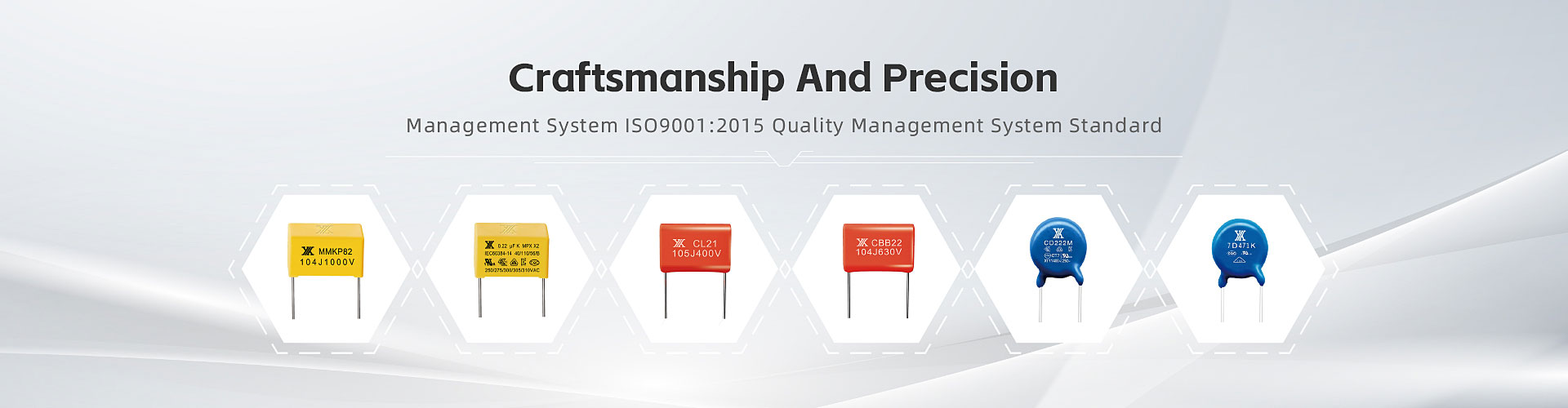
Thin film capacitors and ceramic capacitors are two widely used basic components in the electronics industry. There are significant differences between the two in terms of dielectric materials, performance characteristics, and applicable scenarios. The specific differences are as follows:
Differences in dielectric materials and structures
Film capacitors: Organic films (such as polypropylene, polyester, polystyrene, etc.) are used as dielectrics, and metal foils or metalized films are used as electrodes, which are wound and packaged to make them. According to different film materials, it can be further divided into multiple categories such as CBB (polypropylene), CL (polyester), etc.
Ceramic capacitors: Using ceramic materials as dielectrics, metal paste is printed on the surface of ceramic sheets to form electrodes, which are then sintered and packaged at high temperatures. According to the characteristics of ceramic materials, they can be divided into Class I ceramic capacitors (with good temperature stability) and Class II ceramic capacitors (with large capacity and high dielectric constant).
Core performance differences
Capacity range: Thin film capacitors have a wider capacity range and can achieve microfarads or even millifarads, making them suitable for scenarios with high capacity requirements; The capacity of ceramic capacitors is generally small, mainly ranging from picofarads to microfarads. The upper limit of the capacity of Class II ceramic capacitors is relatively higher, but still lower than that of thin film capacitors.
Accuracy and stability: Thin film capacitors have high capacity accuracy and are less affected by temperature and voltage, resulting in excellent stability; The temperature coefficient of Class I ceramic capacitors is extremely low, and their capacity stability is comparable to that of thin film capacitors, while the capacity of Class II ceramic capacitors is greatly affected by temperature and voltage, and their stability is relatively weak.
Voltage and Ripple Resistance: Thin film capacitors have stronger voltage resistance and excellent ripple current resistance, making them suitable for high voltage and high current working environments; Ceramic capacitors have relatively low withstand voltage and weak ripple resistance, making them more suitable for low voltage and low current circuits.
Loss and frequency characteristics: Thin film capacitors have low dielectric loss, good high-frequency characteristics, and can maintain stable performance in high-frequency circuits; The dielectric loss of ceramic capacitors is also relatively low. Class I ceramic capacitors have excellent high-frequency characteristics and are suitable for high-frequency scenarios such as radio frequency, while Class II ceramic capacitors have slightly inferior high-frequency performance.
Differences in applicable scenarios
Thin film capacitors: commonly used for filtering and energy storage in power circuits, reactive power compensation in motors, signal coupling in audio equipment, as well as high-voltage and high current scenarios such as new energy vehicles and charging piles.
Ceramic capacitors: With their advantages of small size and low cost, they are widely used in power filtering, signal bypass, resonance matching of RF circuits, and circuits of various miniaturized electronic devices in consumer electronics such as mobile phones and computers.
Copyright: Shantou Xinyin Electronic Technology Co., Ltd Support: 11400.cc