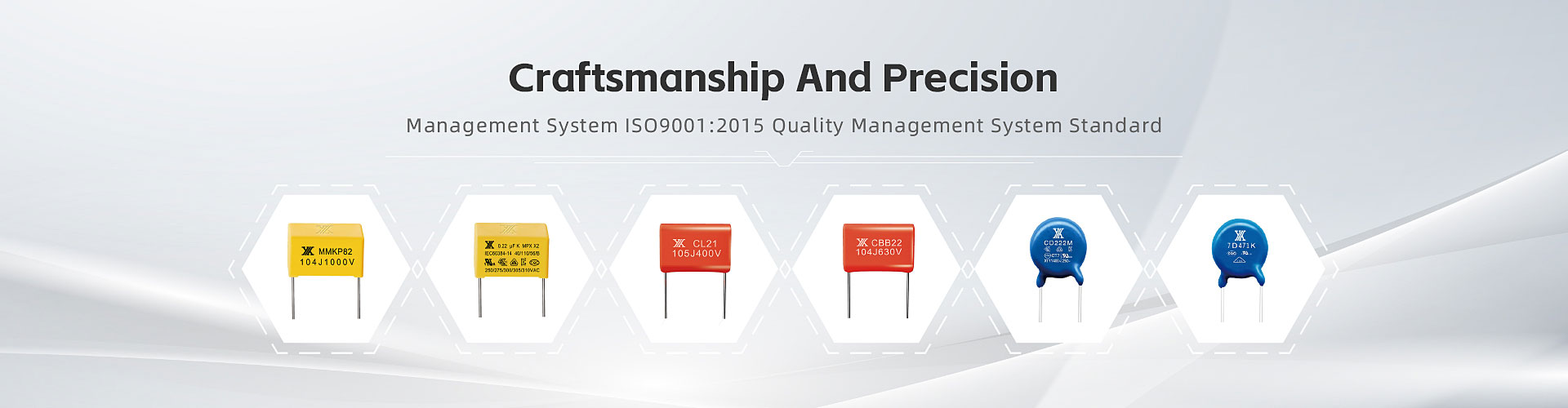
The labeling method of capacitor capacity is mainly based on the type, volume size, and application scenario design of the capacitor. Common methods include the following:
Direct labeling method
Directly labeling the capacitance value and unit on the capacitor casing is intuitive and easy to understand, commonly used for larger capacitors such as electrolytic capacitors and thin-film capacitors.
For example, labeling "100 μ F", "0.1 μ F", "22pF" may also include information such as withstand voltage values and error levels.
Digital annotation method
Commonly used for small capacitors (such as ceramic capacitors), it uses a three digit code * * to represent capacity, with the default unit being * * picofarads (pF) * *.
The first two digits are significant figures, and the third digit is the "multiplier", indicating the number of "0s" to be added after the significant figures.
For example, labeling "103" means adding 3 zeros after 10, corresponding to a capacity of 10000pF=0.01 μ F; Label "221", corresponding to a capacity of 220pF.
If the third digit is "9", it means multiplying by $10 ^ {-1} $, for example, "229" corresponds to 2.2pF.
Number+letter annotation method
Combining numbers and letters to represent capacity, letters can represent both the decimal point position and the unit magnitude.
Letters represent decimal points: commonly seen in small capacity capacitors, such as "1n5" representing $1.5nF $and "2 μ 2" representing $2.2 μ F $(where n and μ represent nanofarads and microfarads, respectively).
Letters represent magnitude: for example, "3R3" represents $3.3pF $, and the letter "R" is equivalent to a decimal point.
Color code method
Color ring labeling similar to resistors, using color rings/dots of different colors to represent capacity values, errors, and withstand voltages, is commonly seen in early or small capacitors and is now less commonly used.
The color of the color ring corresponds to a fixed value, and when reading, it is necessary to distinguish the starting end and calculate the capacity in order.
Do you want me to help you organize a * * capacitor capacity labeling quick reference table * *, summarizing the conversion methods and examples of different labeling methods?
Copyright: Shantou Xinyin Electronic Technology Co., Ltd Support: 11400.cc