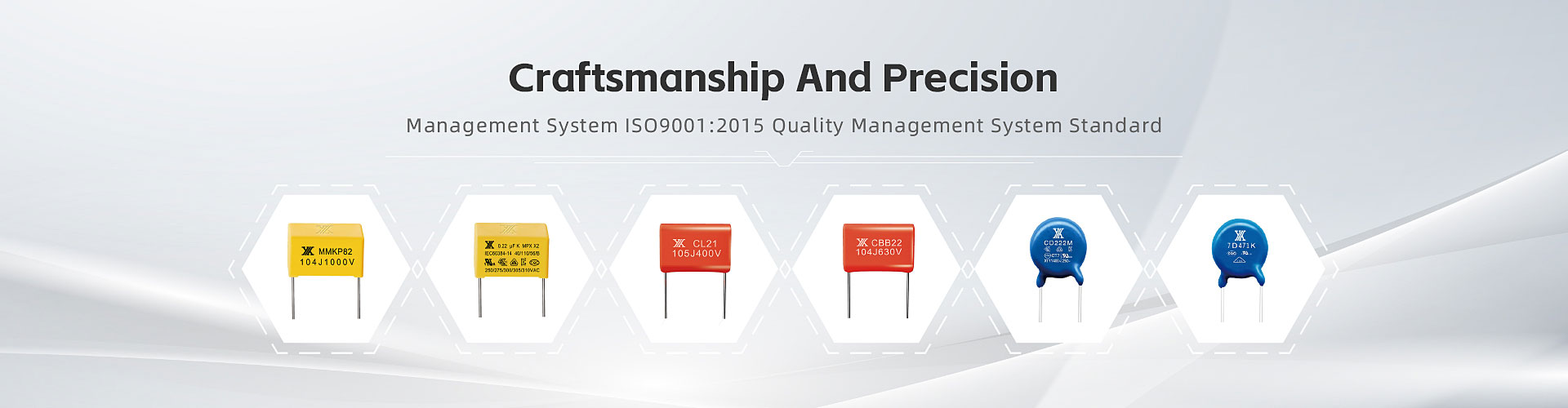
The core principle of capacitive filtering is to use the charging and discharging characteristics of capacitors to "smooth" the voltage or signal in the circuit, filter out unwanted noise components, and retain the target signal or stable power supply voltage.
1. Basic working mechanism: Charge and discharge characteristics of capacitors
A capacitor can be seen as a 'temporary energy storage container':
Charging process: When the voltage in the circuit is higher than the voltage across the capacitor, the capacitor will quickly store electrical energy, and the voltage across the capacitor will rise accordingly;
Discharge process: When the voltage in the circuit is lower than the voltage across the capacitor, the capacitor will release the stored electrical energy to the circuit, supplementing the voltage gap in the circuit.
This dynamic balance of charging and discharging can fill the voltage fluctuations and gaps, making the originally fluctuating voltage tend to stabilize.
2. Filtering Logic in Different Circuits
Filtering in power circuits (most common scenario)
After rectification, the output of the power supply is pulsating DC (voltage fluctuates). At this time, a capacitor can be connected in parallel in the circuit to achieve filtering:
When the pulsating voltage is at its peak, the capacitor charges and absorbs excess electrical energy;
When the pulsating voltage is at its valley value, the capacitor discharges and releases electrical energy to fill the voltage valley.
The fluctuation amplitude of the final output voltage is significantly reduced, becoming a stable DC power, providing stable power supply for subsequent circuits.
Filtering in Signal Circuits
Capacitors can be divided into high pass filtering and low-pass filtering in signal circuits, and the core is to utilize the "on-off characteristics" of capacitors for signals of different frequencies:
Low pass filtering: a capacitor is connected in parallel with a resistor, allowing low-frequency signals to pass through smoothly. High frequency interference signals will be "short circuited" to ground by the capacitor, thereby filtering out high-frequency clutter and retaining low-frequency effective signals;
High pass filtering: A capacitor is connected in series with a resistor, allowing high-frequency signals to be transmitted through the capacitor while low-frequency signals are blocked. It is suitable for scenarios where high-frequency signals need to be extracted.
3. Key influencing factors
The capacity of a capacitor directly determines the filtering effect:
Small capacity capacitor: It has good filtering effect on high-frequency signals and is commonly used to filter out high-frequency noise in power supplies;
Large capacity capacitor: Strong charging and discharging ability, suitable for handling low-frequency fluctuations in power supply, making voltage more stable. In practical applications, large and small capacity capacitors are often combined to achieve filtering effects across the entire frequency range.
Copyright: Shantou Xinyin Electronic Technology Co., Ltd Support: 11400.cc